
Event Recap: «Territories and Autonomous Vehicles» Meetings»
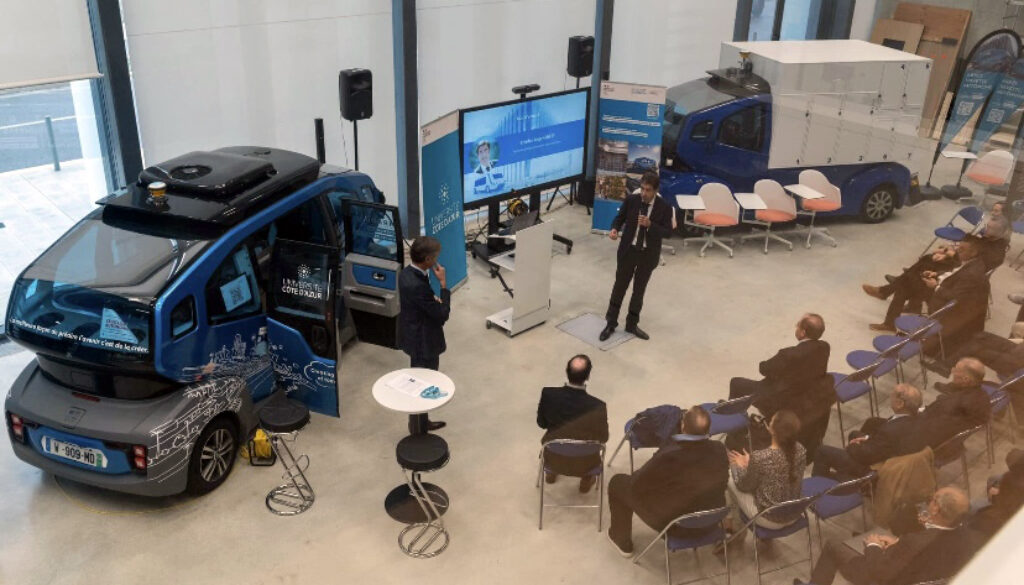
The «Territories and Autonomous Vehicles: a New Paradigm» convention was held at IMREDD on Thursday, 30 November 2023. It brought together a variety of speakers from businesses, local authorities, and academia. all driven by the desire to innovate and experiment with new forms of mobility from a sustainable development perspective. This mobility is embodied by autonomous electric vehicles, contributing to the decarbonisation of the sector and reducing environmental impact; and by shared autonomous vehicles, addressing the challenges of urban population growth (and its mobility needs), as well as social issues related to an ageing population and improving accessibility in rural areas.
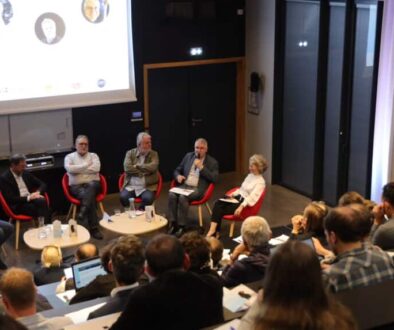
The speakers shared their experience, results, and the difficulties encountered during the experiments they conducted. According to Pierre Revet Servettaz, Municipal Councillor for Digital and New Technologies at the City of Mandelieu-La Napoule, these were «relevant and enriching testimonials» that show the progress made since the beginnings of autonomous vehicles in 2010, and according to Pierre-Jean Barre,.
To chart this path, Université Côte d’Azur and its Fondation partenariale have established a Chair entitled «Territories and autonomous shuttles» backed by the IMREDD's Smart City Innovation Center technological platform. For Paulo Moura, Deputy Director of Innovation, «the Chair offers a space to deepen research, share specialised knowledge and contribute significantly to academic progress in the field of territorial development integrating smart and sustainable mobility in contexts as varied as dense cities to rural villages in the hills».
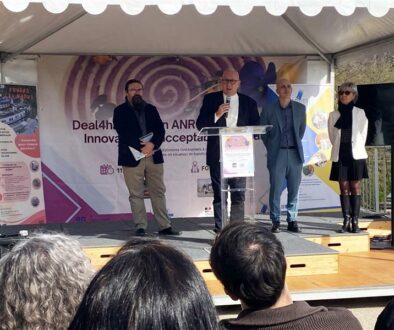
Opening the conference, Charles-Ange Ginesy, President of the Alpes Maritimes Department, outlined the bright prospects for the development of autonomous vehicles in the region, based on the results of the first use cases supported and financed in the area. Carros, a business park and pilot of the «Territoires d'industrie» programme, is seeking to develop mobility services tailored to the needs of the area's employees," explained Marc Raiola, President of the Carros Le Broc Business Club. Mandelieu la Napoule, a seaside resort, is looking to develop new seaside services to meet the needs of local residents and holidaymakers. Cannes, an international events venue, aims to address the issues of visitor travel and port-hotel-city links. Finally, Valberg, a 4-season mountain resort, aims to develop eco-tourism solutions to ensure a high-quality welcome and stay for all visitors and residents," comments Philippe Legrand, Director of Technical Services at Valberg.
In each of these cases, IMREDD engineers Julie Josse, Mehdi Nafkha and Paul Daelman contribute their expertise, based on a 360° analysis, to gain a better understanding of the needs of the user, the company and the region in four dimensions: mobility, quality of life, attractiveness and space, and economic activities and services. Based on the data collected, the analysis is used to establish a model and simulate scenarios incorporating the behaviour of the players involved, the starting point for experimenting with autonomous vehicles and services. The tests then enable the impacts to be specified and the profitability of the use cases to be estimated, an analysis carried out by another IMREDD engineer, Claire Lasserre. The impacts are characterised at different levels: collective, in the sense of strengthening local proximity; cultural, in terms of enhancing local dynamics; social, in terms of strengthening social ties between residents; environmental, in terms of sustainable regional development; and economic, in terms of contributing to local attractiveness. Various parameters are examined: pollution from cars, cardio-respiratory illnesses, reduction in the number of parking spaces, noise pollution, driver stress, accidents, etc., making it possible to define an economic model (cost/benefit) specific to each case of use of the autonomous vehicle.
The future of the autonomous vehicle is therefore taking shape with public transport but also with logistics. For example, as part of the Sustainable City Demonstrator programme, an autonomous shuttle equipped with lockers will be able to trial last-mile delivery between the Saint Isidore Logistics Activity Park and the Parc Meridia district, explains Franck Cannata, Manager of the Transcan group.
The meetings provided an opportunity to put these local experiments into perspective with others that are already underway or have been carried out in the region, for example, as part of the ENA project, at the Sophia Antipolis technology park to serve the entrances to companies within each block, or in Cœur de Brenne, a rural region, to link five communes and facilitate access to services for their fellow citizens. These experiments have made it possible to validate critical technical, organisational and human cases, to test social acceptability and acceptance, safety and, in particular, perceived safety, and also to share knowledge with society and the general public. Sylvie Ponthus, Deputy Director of Mobility and Transport at the CASA, commented on the still premature use of an autonomous shuttle in the public space among other vehicles, without an operator on board, and the need for innovation to support changes in mobility behaviour. Jean-Bernard Constant, Digital Manager of the Communauté de Communes de Cœur de Brenne, insisted on the need for support from town halls, local services and associations, and called for a rethink of land-use planning and the roads of the future (width and 4G coverage). He recommended working on intermodality, linking up with existing mobility services, car-pooling and soft mobility, having more vehicles with smaller capacities, adapting timetables to needs, and increasing the number of stops in each commune. Finally, he emphasises the role of the shuttle as a social link between the communes.
Within the Aix-Marseille-Provence Metropolis region, the «The Camp Demoiselle» project trialled an autonomous electric shuttle service for businesses and organisations in the Duranne business park, operating between Aix-TGV station and the Arbois Campus, with a few intermediate stops. The project's aim was to enhance understanding of this innovative type of vehicle – the Demoiselle, a semi-autonomous electric collective shuttle powered by artificial intelligence – in order to find credible and attractive future alternatives to private cars in peri-urban areas. One finding emerged from the «acceptability» study conducted by The Camp: the public does not yet seem ready to forgo the reassuring presence of a driver, except when it comes to creating a new service: better fire prevention in the hills, serving rural or dispersed areas... explains Michel Gonzales, project manager.
Keolis, transport operator and world leader in shared mobility, has deployed more than 55 autonomous vehicles worldwide. In Saint-Quentin en Yvelines, the first trial with a performance commitment was carried out: a public service delegation for a line of autonomous vehicles integrated into the transport network between the station and several employment areas in the sector, an ambitious route on an open road with real complexities. The trial proved conclusive in terms of overall performance," explains Clémentine Barbier, Head of Autonomous Mobility, "but with a level of patronage that fell short of expectations. Nevertheless, the trial has enabled new tools to be developed to measure, objectify and optimise the service: a Fleet Management System (FMS) tool designed to retrieve the data passing through the APIs of the autonomous vehicles and transform it into service indicators; a counting and reporting application for the operators; real-time updating of station arrivals in the Ile-de-France Mobilités tools.
Over the last 6 years, Keolis has been testing level 3 autonomous shuttles at its SEMA (Site d'essai des mobilités autonomes) test site (a classification defining a semi-autonomous means of transport that allows the driver to «let go of the wheel» in certain low-risk situations, such as traffic jams or car parks). Our strategy is based on 4 pillars," explains Clémentine Barbier, "safety, service, skills development and social acceptability. In terms of safety, Keolis is offering an operator test bench at the national shooting sports centre in Chateauroux, targeting the transport of athletes and transport-on-demand journeys without an on-board operator. In terms of service, Keolis is committed to more complex use cases to challenge the technology: university campuses, rural sites, pedestrianised city centres, airports, shopping centres, hospitals, industrial sites, etc. In terms of skills development, Keolis is working hand in hand with drivers on issues of maintenance, service design and supervision of level 4 vehicles (fully automated driving). Finally, when it comes to the social acceptability of autonomous mobility services, Keolis works with all the stakeholders: mobility organising authorities, public transport operators and passengers, taking an interest in the perceived service by using feedback to improve the passenger experience.
Finally, the meetings provided an opportunity to take stock of the technical difficulties that need to be overcome if autonomous vehicles are to be deployed on a large scale in the future. The first constraint is anticipating the behaviour of other road users. This is due to insufficient detection distances, or even the impossibility of detection under certain conditions, combined with the difficulty of mapping the environment in high definition. Other constraints include the interpretation of the situation by the artificial intelligence, the complexity of the decision-making schemes and the protection of the data collected to prevent possible cyber-attacks. Researchers such as Massimiliano Lenardi, head of the HITACHI European R&D centre, and Rémy Sun, researcher in the Models and Algorithms for Artificial Intelligence (MASSAI) team at Inria, are working on all these issues. Investment in R&D must therefore continue to make the future of autonomous vehicles a reality.
 Français
  English (UK)