
DEAL4HAND: review of a project exploring 3D food printing for people with disabilities
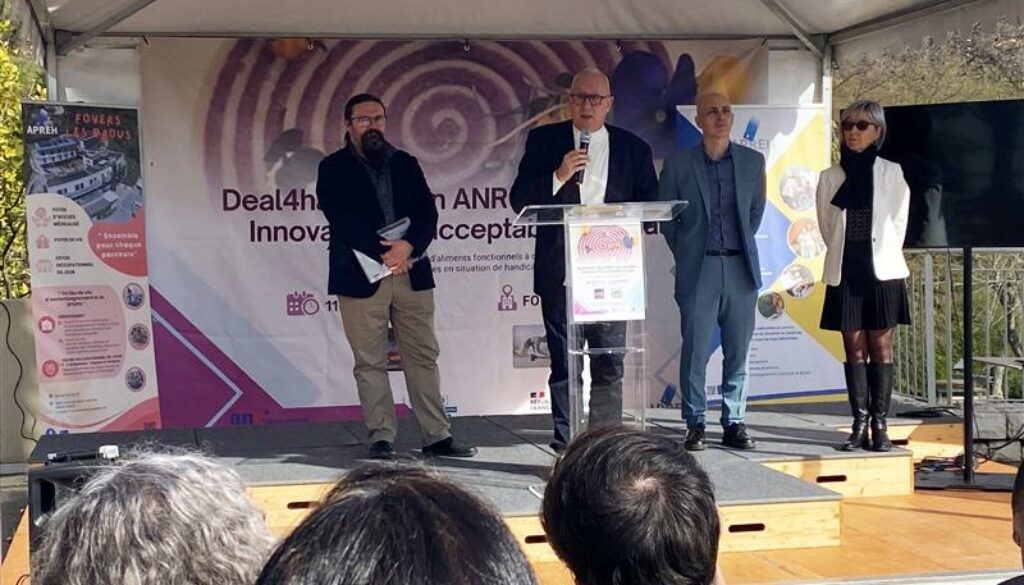
On 11 March 2026, the Foyer Les Baous in Vence hosted a morning of feedback dedicated to ANR DEAL4HAND Project Report, bringing together researchers, social and healthcare professionals, institutional partners, and residents. Organised by the APREH association with the project's scientific partners, this meeting provided an opportunity to review nearly two years of experiments involving the 3D printing of adapted foods.
Launched in June 2024, the project DEAL4HAND – Digital design of functional foods for people with disabilities explore the use of digital design and 3D printing to create food tailored to the nutritional needs and chewing or swallowing abilities of certain populations. The aim is to improve food accessibility while maintaining the pleasure and sensory experience of eating.
A real-world experiment
The project notably involves the QuaPA unit of INRAE Clermont-Auvergne-Rhône-Alpes, Université Côte d’Azur, and the APREH association, which manages the Foyer Les Baous, where the experiments are taking place.
For almost two years, residents, carers, cooks, and healthcare professionals have been directly involved in evaluating a 3D-printed food production process. This approach allows for concrete testing of the use of these new technologies in a real-world setting, as close as possible to the needs of the individuals being supported.
Understanding the social acceptability of innovation
Beyond the technological aspects, the project is also interested in how these innovations are perceived by the various stakeholders involved.
This dimension is the subject of work being carried out by Vincent Meyer, a professor at Côte d’Azur University, who analyses the representations and uses of printed food among residents, caregivers and catering teams. This research helps to identify the social and cultural conditions that encourage or hinder the adoption of these new eating practices.
The IMREDD engaged in action-research approaches
Project partner, the IMREDD – Côte d’Azur University is part of this research-action dynamic aiming to bring scientific production and concrete experiments closer together.
The institute notably hosted initial exploratory tests concerning 3D food printing before the experiments were gradually transferred to Foyer Les Baous. This collaboration illustrates the value of developing interdisciplinary projects associating researchers, local stakeholders, and end-users.
Perspectives beyond the project
The morning also allowed for a discussion of the prospects opened up by this work. The partners wish to continue this momentum in order to further explore the opportunities offered by food printing to support people in difficulty.
Among the avenues being explored is the development of new generations of food printers capable not only of structuring food but also of cooking it directly during the printing process.
At the crossroads of scientific research, technological innovation, and in situ experimentation, the DEAL4HAND project illustrates a collaborative approach to innovation focused on concrete applications for practical use.
 Français
  English (UK)