
5 Oceans, 5 Colonies
Presentation
«Every age demands its own form», wrote Bauhaus architect Hannes Meyer in his 1926 essay «The New World». We live in an uncertain world where the desire to explore, design and inhabit the oceans is growing rapidly. As land resources dwindle and environmental crises worsen, it is imperative that we radically rethink the way we live with, on, above and below the ocean in order to anticipate, adapt and prevent.
In response, IMREDD's UX & Future of Living Architectural Lab invites cross-disciplinary professionals, researchers and students (architects, designers, engineers and speculative thinkers) to embark on an 11-day experimental summer lab: a nomadic, hands-on laboratory, a place to explore, stimulate, simulate and test disruptive ideas for the «Brave New World»¹ of future living, where humanity thrives in extreme marine environments.
Why now?
The ocean world is at a breaking point
- 410 million people will be threatened by rising sea levels by 2050.
- 50 % of coral reefs could disappear by 2050 due to rising temperatures (UNEP).
- Plastic or fish? By 2050, plastic could outweigh marine life in weight (Ellen MacArthur Foundation).
- Ocean acidity has increased by 30 % since the industrial revolution and is expected to rise by 100 to 150 % by 2100 (NOAA/GIEC).
- Deep-sea mining and the collapse of biodiversity are accelerating at an alarming rate.
- Growing awareness, supported by political and legislative bodies, is driving efforts to regulate and address ocean-related challenges. Key initiatives include: (i) the Political Declaration of the 2022 UN Oceans Conference, (ii) the UN SDG target 14.2 on the sustainable management and protection of marine ecosystems, and (iii) the Third United Nations Conference on the Oceans (UNOC) to be held in Nice, France in 2025.
- The transition to living in, with and thanks to the oceans is accelerating rapidly, as shown by the results of the «Future Human Habitat» scenario project of the IMREDD User eXperiences for Smart Life Chair.
The challenge
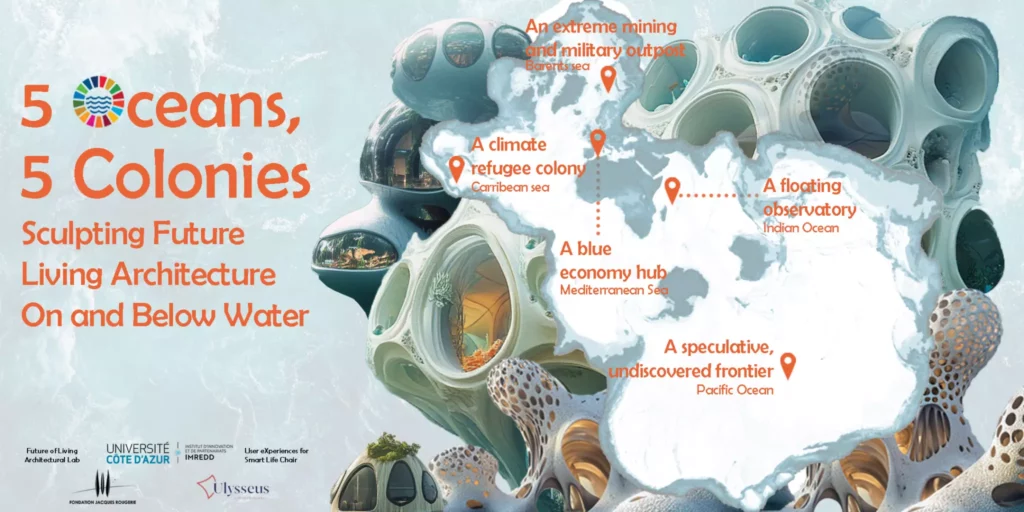
SCULPTING SPECULATIVE OCEAN COLONIES IN EXTREME ENVIRONMENTS AND SURVIVAL CONDITIONS
- Indian Ocean - A floating observatory and a marine conservation habitat.
- Caribbean Sea (Gardi Sugdub Island) - A colony of climate refugees resisting rising sea levels.
- Barents Sea - A mining and military outpost in an extreme environment.
- Mediterranean Sea - A blue economy cluster rethinking the region's resource flows.
- Pacific Ocean - A speculative and unexplored frontier to be determined by the participants.
The process
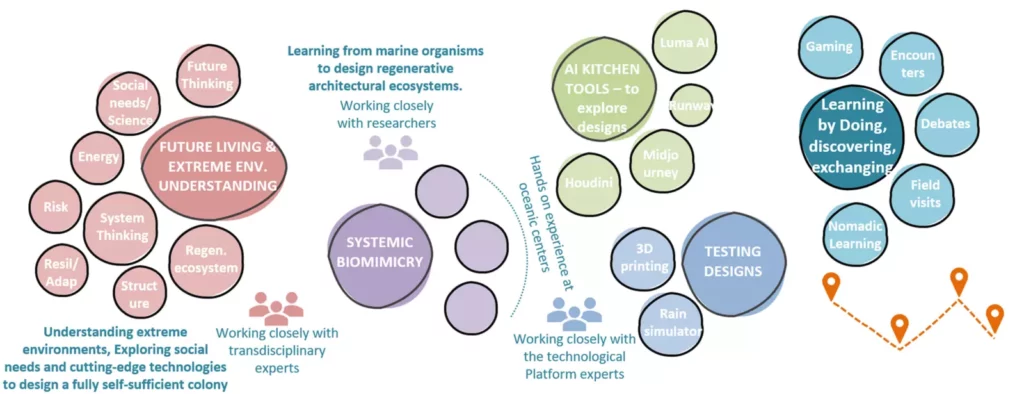
A nomadic and practical summer school, driven by a non-formal, experimental and transdisciplinary process, and guided by fundamental thematic concepts. This summer school is not about conventional architectural design, but about speculative and futuristic experiments and live simulation workshops. Participants will follow the following modules:
- Understanding future lifestyles, extreme environments and survival conditions - Exploring social needs and cutting-edge technologies to design a fully self-sufficient colony.
- Systemic biomimicry - Learning from marine organisms to design regenerative architectural ecosystems.
- AI kitchen tools - to explore designs.
- Testing designs in real ocean conditions - using 3D printers and rain simulators.
- Learning by doing, discovering and sharing - field visits, meetings and fun activities.
Programme structure
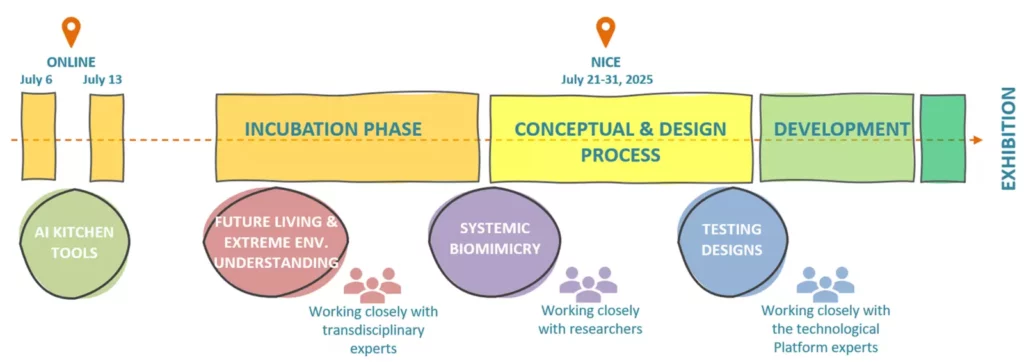
Through hands-on learning, immersive experiences, exploration, observation and knowledge exchange, the programme is structured into two main phases:
Summer pre-course: (online)
Two half-day online sessions designed to provide participants with essential knowledge of Kitchen Tools AI tools to support and enhance the design process:
Summer courses: (face-to-face)
Incubation phase: Focus on understanding future lifestyles, survival in extreme environments and developing initial concepts and programmes for ocean colonies.
Conception and design phase: A deep dive into systemic biomimicry through the observation and exploration of living systems, in collaboration with researchers and ocean explorers. Participants will apply biomimicry methods using AI tools, 3D printers and physical rain simulators.
Final development phase: refining concepts and preparing final deliverables.
Installation and public exhibition: presentation of the final results in a public exhibition, an opportunity to share the work, interact with the public and liven up the public space in Nice.
Deliverables (L) and Key Opportunities (KO)
- A one-minute animated video produced using AI, presenting the project, its process and its concept (L)
- A summary table in A0 format presenting the process and the final result (L)
- A public exhibition transforming Nice's urban spaces, inviting citizens, policy-makers and the international public to interact with visionary prototypes (OC)
- Biomim'expo 2025 (Marseille, 28 October 2025) - An opportunity to present at the exhibition the work developed during the summer university (OC)
- Preparing the ground for the 2025 International Architecture and Innovation Competition (Fondation Jacques Rougerie - Académie des Beaux-Arts) (OC)
To remember
- Practical expertise in systemic biomimicry and AI-enhanced architectural design processes.
- An experimental design process in extreme environments and survival conditions.
- Systems thinking, critical foresight, disruptive and regenerative design strategies for the marine future.
- Qualitative learning about marine ecosystems.
- The journey of translating scientific experience and know-how into lifelong learning, empowerment and lasting impact.
Facilitators
A diverse group of contributors from various fields and ecosystems is actively involved in the various phases of the summer school, from concept development and preparation to implementation and post-event follow-up. This ecosystem is a dynamic mosaic of renowned experts, adventurers and visionaries from the public and private sectors, each bringing unique perspectives and skills to enrich the experience of participants.
Open to speculative trans-disciplinary thinkers, professionals, researchers and students (PhD and Masters level, but also senior undergraduate) from all over the world in the fields of architecture, design, engineering, urban planning, environmental sciences and related fields, this programme is aimed at those who wish to break disciplinary boundaries, engage in extreme survival simulations and push back the boundaries of what is possible.
To ensure a top-quality experience, only 20 to 25 participants will be selected.
Training from BAC+3 in architecture, design, engineering, urban planning, environmental sciences and related fields, or equivalent experience.
 Français
  English (UK)