
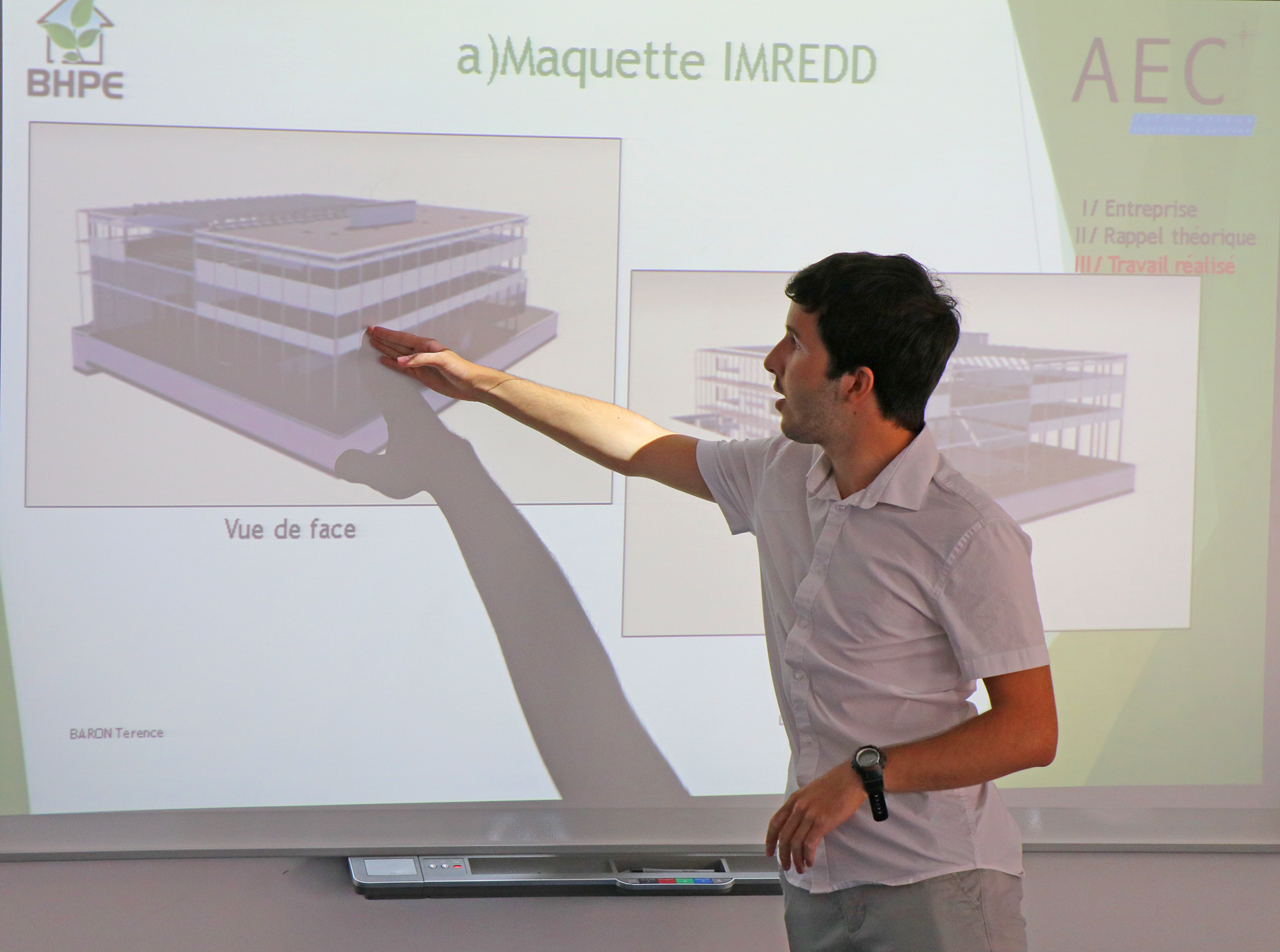
Interview: Digital mock-up of the future IMREDD building
Terence BARON, a young student who defended his dissertation at IMREDD in September, agreed to talk about his background and experience by answering a few questions.
Je suis un grand modèle linguistique, entraîné par Google.
My name is Terence Baron, I am 21 years old and I am a third-year student studying for a BHPE degree, specialising in Building Information Modelling (BIM), at IMREDD. This involves the 3D modelling of buildings. Today, when constructing a new building, the first thing to do is to model it in 3D, this allows us to define who does what, when, and how.
Quel est votre parcours ?
After obtaining my Baccalaureate in Science and Technology for Industry and Sustainable Development (STI2D) and a BTS (Higher National Diploma) in Fluids, Energy, and Home Automation, I became very interested in the energy sector. Following this and some research, I learned about the BHPE course, which I completed at IMREDD. Initially, when I started the course, I didn't think about BIM at all; I had vaguely heard of this specialisation without knowing much about the subject. Subsequently, through my work-study programme, I had the opportunity to work on BIM and develop my knowledge, and I didn't hesitate for long to seize it.
What company have you chosen for your apprenticeship?
I completed my year of work-study at AEC INFORMATIQUE, where I was trained on the software «Revit,» which is the essential tool for 3D modelling. Following this training, I was able to work on the new IMREDD building, where I learned a great deal about work methodology and the business world.
What is the topic of your dissertation; how did you go about it?
The subject of my thesis is the digital model of the future IMREDD building. I have therefore worked on its modelling.
It's important to know that there are many things to do before you start modelling. I've adopted the methodology that my corporate experience has allowed me to acquire to establish the different stages of my project. Initially, I set up the mock-up. With the help of my colleagues, I put it in the correct place, which allowed us to detect certain inconsistencies in the measurements initially provided. We then defined which data would be prioritised, depending on the project's progress. At first, it was data about the structure, which gave us a first overview of the building's exterior appearance and allowed us to check the placement of different elements; for example, if the partitions but not the floor were visible in the render, we knew something was wrong and needed to be adjusted.
Regarding modelling, we proceeded from the bottom up, following the same process as when constructing a building in real life.
 Français
  English (UK)