
Interview : Fuel cell for the future IMREDD building
Richcard Brevil, Master 2 N.I.C.E. student (Nano&Materials. Industry&Management. Design&Quality. Energy&Environment) at IMREDD, answers a few questions about his work on the fuel cell that will be integrated into his future building.
Can you introduce yourself in a few words?
My name is Richcard Brevil, and after completing a technical baccalaureate (Technological Innovation and Eco-design) in French Guiana, I did a BTS in Construction Studies and Economics near Antibes. I then wanted to develop my skills in energy management in the building industry. That's when I joined IMREDD to do a BHPE (High Energy Performance Building) degree. Once I'd obtained my bachelor's degree, I went on to do a Master 1 in EME (Energy, Materials and Environment), and I wasn't disappointed, as this year's rich teaching naturally made me want to continue with a Master 2 in MQM (Materials, Quality and Management).
What is the subject of your dissertation?
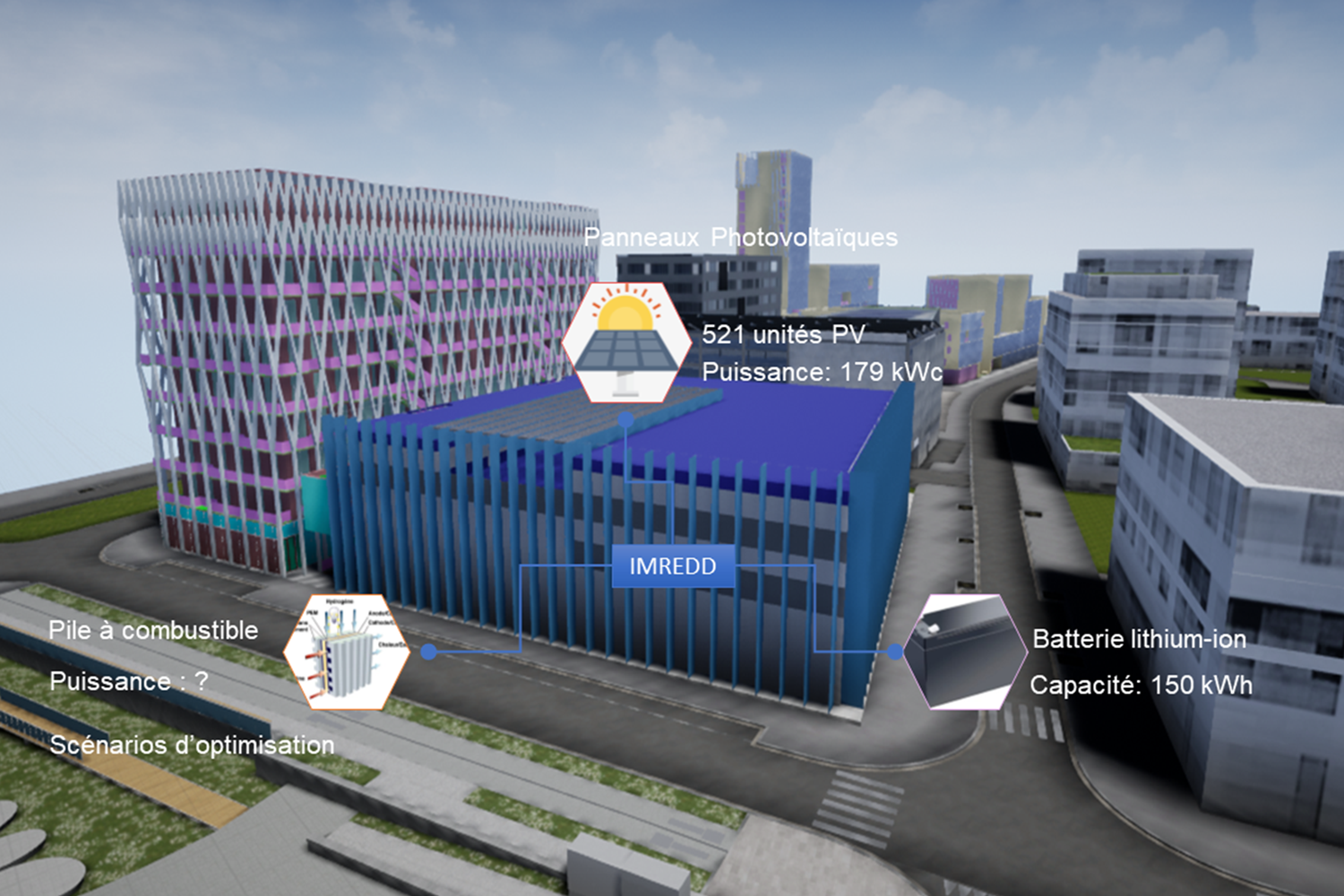
My work consisted of a technical and economic analysis of a fuel cell coupled to the IMREDD energy network. The study focused on the fuel cell that will be integrated into the future IMREDD building, a system that is well recognised and widespread in countries such as Japan and the United States, but unfortunately less so in France.
How did you structure your work?
The work on this subject took place over two years. During the first year of the Master's programme, I carried out a mainly bibliographical study in order to learn as much as possible about the subject, document myself and prepare the ground for the practical part. In the second year, I had to design a system that would meet IMREDD's objectives for integrating the system into its new building.
I also collected data that enabled me to analyse the building's energy consumption and the battery's capacity. It should be noted that when the building produces a surplus of energy at certain times of the year, some of it can be stored in the battery and the rest fed into the standard grid.
Finally, part of my internship was devoted to budgeting for this proposal in order to determine whether it was economically feasible to set up such a system, which is why we called the study a «technical-economic» study.
Will your work directly benefit the energy management of the future IMREDD building?
Absolutely, this work is a real study that will be used as part of the construction of the building. The fuel cell is a project that needs to be developed to follow on from the other energy production systems integrated into the building (photovoltaic panels and a micro wind turbine).
The study I carried out was the very first in a long series of more detailed and sophisticated studies, particularly on the installation of the mechanism and the simulation of the building's heating and cooling consumption.
Have you encountered any difficulties in the course of your work?
When I was given this assignment, I knew that I would have to show a certain amount of autonomy in my work, but the problem was that I was a little too autonomous and I didn't communicate enough about the progress of my work to the people who supervised me. The project tended to evolve, which didn't allow me to systematically update the new information and data; my tutor explained to me the importance of communication in the work and especially in this type of project so that the different collaborators were synchronised on the stages of progress in the work.
I also had to understand the subject and the needs of the client (IMREDD) as well as the purpose of the project, which wasn't easy for me at first. Sometimes I got lost in details that were of little or no use to the project, but with the help of my supervisors I quickly refocused on what was most important.
What are your plans for the future?
I've already had a few contacts with companies, including one with a company located near the future IMREDD building, and the discussions are still ongoing. At the same time, I'm taking part in other interviews, for example with a company based in Monaco, which gives me good hope that I'll end up with a job. So if I have to sum up, I'd say that my objective for the future is to develop and grow in a stimulating and productive job and working environment.
 Français
  English (UK)