
Parc Méridia: a demonstrator for experimenting with the sustainable city of tomorrow
Soil regeneration, urban farming, circular economy, smart mobility: The Parc Méridia project is moving into its operational phase. As a winner of France 2030«s national »Sustainable City Demonstrators’ programme, it brings together local authorities, researchers and economic stakeholders around a common goal: to trial new solutions to support regional transition. L’IMREDD – Université Côte d’Azur is one of the partners involved in this innovation initiative across the Écovallée.
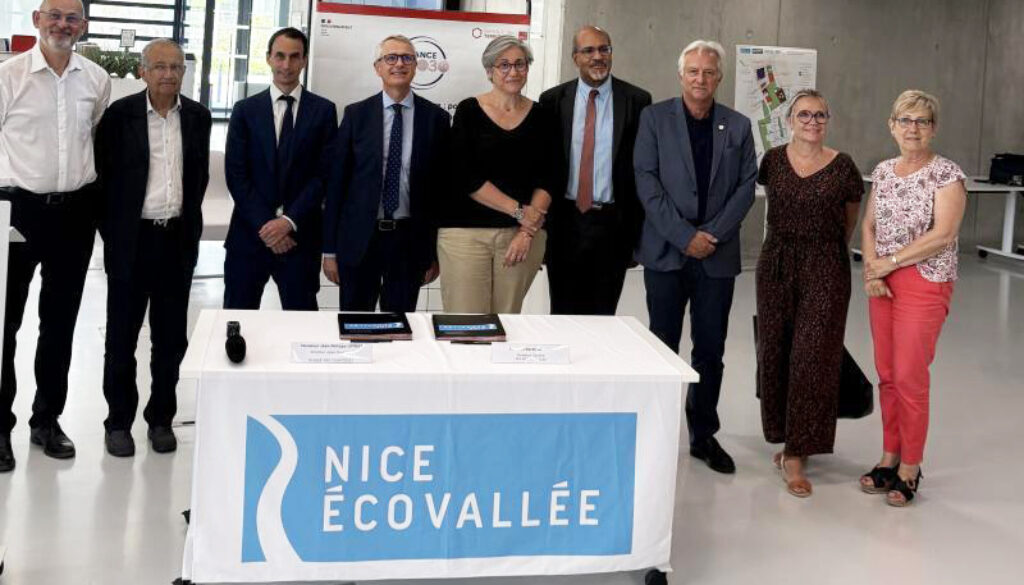
The signing of the commitment agreement between EPA Nice Écovallée, the Banque des Territoires and the project partners marks an important milestone in the development of this future 64-hectare neighbourhood, situated at the heart of the Nice Écovallée National Interest Project. Thanks to support from €6 million, several experiments designed over the past few years will now be able to be deployed in the field in order to prepare for the emergence of a Sustainable productive city, balancing economic development, quality of life, and environmental preservation.
Restore soils and preserve resources
Among the most iconic actions is the implementation of innovative techniques for Ecological soil regeneration. The objective is to restore degraded land by drawing on natural living mechanisms, particularly the activity of soil microorganisms. This approach makes it possible to avoid the massive replacement of land and to limit the impacts associated with the transport of materials.
Already underway on several pilot sites, this experiment could be extended to part of the future Var plain landscape park, as well as to the public spaces of the ZAC. Beyond its environmental benefits, it paves the way for new development practices that are more resource-efficient and better adapted to climate challenges.
Imagining new urban models
The demonstrator also aims to experiment with new forms of urban mixed-use. A building combining productive activities, offices and housing This should, in particular, make it possible to better link living and working spaces within the same neighbourhood. This thinking is part of a broader ambition: to promote proximity of uses and to build an area capable of accommodating housing, economic activities, shops, services, and public facilities all together.
The project also involves the development of a local sector for’Urban and peri-urban agriculture, in connection with the agricultural spaces preserved near the site. Reflections are also being carried out on’circular economy, notably to enhance the value of materials from construction sites and to strengthen synergies between regional stakeholders.
IMREDD is committed to the mobility solutions of tomorrow
As a project partner, IMREDD – Université Côte d’Azur is contributing to the research and innovation work being carried out as part of the demonstrator. In particular, the institute is leading the development of a Logistics and mobility flow modelling tool intended to better understand movements related to the district's economic activities and to optimise their organisation.
This contribution illustrates the role of IMREDD in supporting regional transitions through approaches based on experimentation, applied research and cooperation between public, private and academic stakeholders. The various initiatives undertaken as part of Parc Méridia will continue until 2031 and will enable the evaluation, under real-world conditions, of solutions likely to inspire future urban projects in France and across Europe.
(c) Photo: Tribune Côte d’Azur
 Français
  English (UK)